Why the Best Way to Handle Toxicity Might Be to Stop Talking: 5 Impactful Truths About Strategic Separation
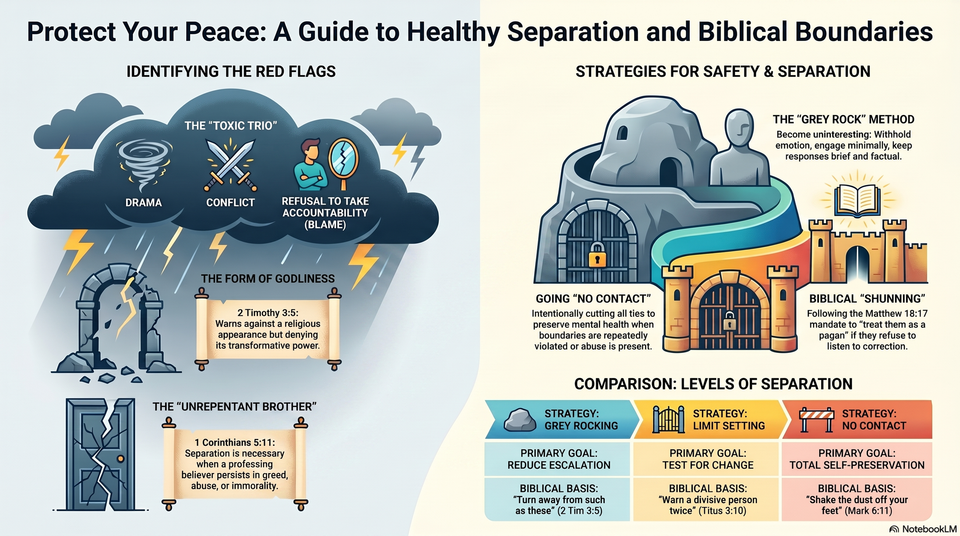
The modern ideal of the "open door" policy in relationships is often presented as the pinnacle of grace and patience. We are conditioned to believe that keeping lines of communication perpetually open is a moral mandate, regardless of the cost. However, maintaining high-access relationships with individuals who habitually violate boundaries or engage in manipulative behavior exacts a profound toll. This relentless accessibility often manifests as a deep-seated mental and physical exhaustion, where the "open door" becomes a conduit for stress that degrades our very vitality.
It is a significant ethical misconception that the command to "love your neighbor" necessitates granting unrestricted access to your psychological and spiritual life. In both ancient ethical wisdom and modern clinical practice, there is a recognized necessity for what we might call a tactical "no contact" period. This is not an act of malice, but rather an act of stewardship. It is the realization that true love sometimes requires a firm "no" to protect the integrity of the environment required for health and holiness.
To maintain a flourishing social and spiritual ecosystem, one must learn to be the gatekeeper of their "inner yard." This guide bridges the gap between the rigorous community standards of the ancient world and the protective strategies of modern psychology. By synthesizing these perspectives, we can find a compassionate yet firm path to reclaiming our peace and spiritual integrity.
1. The "No Table" Rule: Why Fellowship Has a Price
In the Greco-Roman context of the early church, the concept of koinonia—or fellowship—implied a profound level of shared life, responsibility, and mutual endorsement. Sharing a meal was not merely a social convenience; it was a sign of total association. This historical context illuminates the directive in 1 Corinthians 5:11, which commands a refusal to even "eat with such a person." This was not a general mandate to shun the "people of this world," but a specific internal discipline for those within the community who claimed to share the same values yet lived in flagrant contradiction to them.
Withholding association serves as a vital moral boundary. When we continue to "sit at the table" with a "brother or sister" who is habitually abusive or deceptive, we inadvertently offer a sign of acceptance that can validate their destructive path. Modern "no contact" strategies echo this ancient wisdom; by removing the "supply" of our presence, we create a necessary vacuum that forces the other party to confront the reality of their choices without the comfort of our validation.
"But now I am writing to you that you must not associate with anyone who claims to be a brother or sister but is sexually immoral or greedy, an idolater or slanderer, a drunkard or swindler. Do not even eat with such people."
1 Corinthians 5:11
2. Form vs. Power: Spotting the "Spiritual Facade"
The Ethical Scholar must distinguish between religious performance and genuine character. 2 Timothy 3:5 warns of a specific type of toxicity: individuals who possess "a form of godliness but deny its power." This "hollow religion" poses a risk to the community because it uses the language of virtue to mask a lack of internal transformation.
To protect your inner yard, you must look past the facade to see if there is actual "power"—the capacity for the Spirit to change a person’s behavior.
- The Outward Form: This includes the use of religious jargon, public rituals, and an appearance of "moral respectability" used to gain trust or leverage.
- The Internal Transformation: This is evidenced by a genuine shift in character, marked by humility, accountability, and a lifestyle that matches their claims.
Separating from those who settle for ceremony over conversion is a protective measure. It prevents the "moral contagion" that occurs when we allow high-level influence to those who reject the very values they profess.
"Having a form of godliness but denying its power. Turn away from such as these!"
2 Timothy 3:5
3. The Three Red Flags: Drama, Conflict, and the Blame Game
Former Secret Service agent Evy Poumpouras offers a powerful perspective on environmental protection. In her work, she notes that agents protect the physical life of a leader by rigorously vetting every person who approaches the "inner circle." We must adopt a similar "bouncer" mentality for our psychological lives. Poumpouras emphasizes that people are "contagious"—just as being around brave agents made her braver, being around toxic individuals will infect your mindset. She identifies three specific types of people who wreck boundaries:
- Drama: These individuals live in a state of constant, "hot volcano" crises. Drama is never contained; it "leaks" into your world, eventually making their emergencies your responsibility.
- Conflict: Some people are addicted to the adrenaline rush of disagreement. They have problems with bosses, parents, and peers alike. Their presence ensures that your environment remains in a state of chaos rather than growth.
- Blaming: "Blamers and complainers" refuse to take accountability. By insisting they are at the mercy of everyone else’s actions, they remain stagnant and pull their associates into a cycle of victimhood.
Becoming the "gatekeeper" of your life is a survival skill. If you allow everyone in without a "ticket," you cannot be surprised when your inner world is ransacked.
4. The "Grey Rock" Strategy: Starving the Manipulator
When total separation is not immediately possible, modern psychology offers the "Grey Rock Method" as a form of emotional self-defense. As Bree Williams, LPCA and Group Facilitator at Charlie Health, explains, the goal is to become as uninteresting and non-reactive as a plain grey rock. Narcissists and manipulative abusers thrive on "emotional supply"—the reaction they get when they provoke you.
The tactics include:
- Withholding Emotion: Maintaining a calm, impassive facial expression and tone regardless of the provocation.
- Minimal Engagement: Giving brief, factual, "yes/no" responses that divulge zero personal feelings or details.
- Avoiding Eye Contact: Limiting the attention and validation that the manipulator seeks.
By becoming "bland," you effectively starve the manipulator of the power they crave. They eventually move on to find a more "interesting" target who will provide the emotional response they desire.
"Grey rocking is a deliberate strategy where an individual minimizes emotional expression and becomes as unresponsive and uninteresting as possible... it serves as emotional self-defense." — Bree Williams, LPCA
5. Restoration Over Revenge: The True Goal of Discipline
The "soft side" of strategic separation is its ultimate intent: restoration. Ethical separation is never about revenge or "winning" an argument; it is "corrective love." As noted in
2 Thessalonians 3:14-15, the goal is to create a boundary so stark that the individual feels the "shame" of their isolation and is awakened to a need for repentance.
This requires a delicate, scholarly balance:
- The Erring Brother: We are told to "not associate," but also to "not regard him as an enemy." We recognize the offender as a person in need of help, not a target for our vitriol.
- The Permeable Door: Boundaries should not be permanent walls but "permeable doors." They stay closed to protect the innocent, but they are designed to open if the individual takes true accountability and demonstrates a sustained change in behavior.
"Yet count him not as an enemy, but admonish him as a brother... he is a man and a brother still; he is to be followed with tender sympathy and prayer." — Albert Barnes' Notes
Reclaiming Your "Inner Yard"
Reclaiming your "inner yard" is an act of high-level stewardship over the life you have been entrusted to lead. In emergency medicine, the first priority is checking the "ABC" vitals. We can apply this same diagnostic to our relational health:
- Air: Does this relationship give you the space to breathe and think clearly, or is it suffocating you with drama?
- Breath: Is there a healthy, life-giving rhythm to the interaction, or are you constantly gasping for a break from the chaos?
- Circulation: Is there a reciprocal flow of respect and support, or is the relationship a "clog" that stops your emotional and spiritual progress?
If a relationship has stopped your vitals, strategic separation may be the only way to survive. As the gatekeeper of your own life, ask yourself: Who have you let in that currently lacks a ticket, and what would happen to your peace if you finally closed the door?
 Bev Garcia